
The Curves That Killed: Silicone, Showgirls & the Price of Beauty
Before regulated fillers, before BBLs, before any of it, women were injecting industrial silicone into their bodies at secret "pumping parties." It's one of the darkest chapters in the history of my field — and, uncomfortably, one of the most human.
This is the story of how it happened, who it harmed, and why it never really went away.

Let me tell you about a party you would not have wanted to be invited to.
In the hotel rooms and backstage dressing rooms of post-war America, a very particular kind of gathering took place after dark. Cash only, no names, spread by word of mouth. Someone would arrive with a syringe and a supply of liquid silicone — often the same grade used to insulate industrial transformers — and, one by one, the guests would be injected.
Breasts, hips, cheeks, lips.
Instant curves. No consultation, no consent form, no follow-up, and frequently no idea what was actually being put into their bodies.
They were called “pumping parties.” And to understand why anyone would take that risk, we have to start with what the world was telling women their bodies should look like.

The post-war body ideal
The 1950s ushered in a new and very demanding silhouette. The androgynous flapper of the 1920s was long gone; in her place stood the hyper-feminised hourglass — Marilyn Monroe, Jayne Mansfield, Sophia Loren. The bust, in particular, was recast as shorthand for femininity, glamour and desirability all at once.
The problem was that the medicine hadn't caught up with the ideal.
Surgical breast augmentation barely existed yet — the first silicone breast implant wouldn't be developed until 1962 — and what surgical options there were tended to be crude, expensive or genuinely dangerous.
So when a shortcut appeared that promised the look for a fraction of the price, in an afternoon, the demand was already waiting for it.
From the docks of Yokohama
Here's the origin story, and it's grubbier than the polite version usually told.
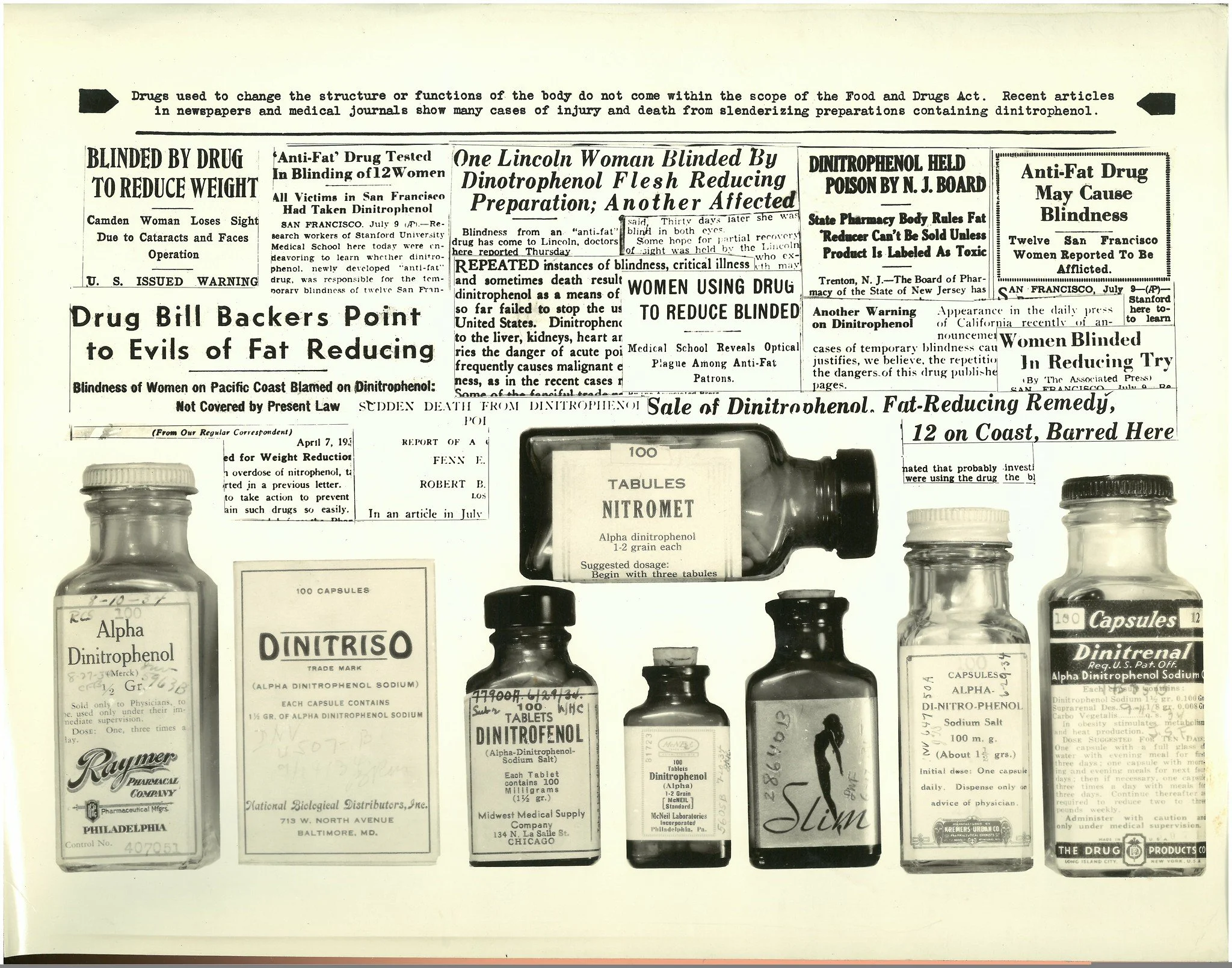
After the Second World War, American army quartermasters in occupied Japan noticed something odd: drums of Dow Corning 200 fluid — an industrial silicone used as transformer coolant — were quietly disappearing from the Yokohama docks. The silicone was being injected, by lay practitioners, into Japanese sex workers seeking fuller, more "Western" figures to appeal to American servicemen. This wasn't a proper medical procedure. It was black market, working with stolen machine fluid.
The practice sailed to the United States and put down roots exactly where you'd expect: Los Angeles, Las Vegas: the world of showgirls and pin-ups. It acquired a veneer of respectability from a physician named Dr Sakurai, who set up in Beverly Hills and popularised a "formula" that cut the silicone with vegetable and mineral oils to change how it behaved in tissue. Others added so-called "scarring agents" to try to lock it in place. None of it was safe. Thousands of women — by some accounts injected with enormous volumes — were the test subjects for techniques nobody had properly studied.
By the 1960s, a purer product existed: Dow Corning's medical-grade fluid, and later a specific formulation, MDX‑4‑4011, prepared for a formal FDA investigation. But medical grade or not, the material was leaving the clinic and being sold on. Burn units and veterinary suppliers became the primary anonymous sources. The genie was out of the drum.
Vegas Showgirls

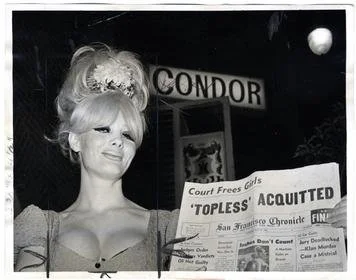
Doda in 1965.
To understand how deep this went, you have to go to where the stage lights were brightest, because the entertainment world didn't just dabble in silicone — it ran on it. And nowhere took that to heart like Nevada. Of the roughly 50,000 American women thought to have been injected with liquid silicone across the post-war decades, an estimated 10,000 were waitresses and showgirls working in Nevada alone. Think about what that number means. This wasn't a handful of starlets chasing a look — it was something closer to an entire workforce quietly remodelling itself one syringe at a time, because on the Strip a fuller figure meant better spots on the bill, better tips, and the difference between a booking a job or not.
And then there was Carol Doda, who turned the whole thing into a headline. On the night of 19 June 1964, a 26-year-old dancer walked onto the stage of the Condor Club in San Francisco's North Beach in a topless monokini and became the first well-known topless entertainer of the era — lowered to the floor on a white grand piano, an overnight sensation, the talk of the city. To meet the moment, she did what the era offered: silicone. Over a run of sessions she had 44 separate injections, around $1,500 worth, that took her from a 34B to the famous "twin 44s" — the bust a local wit christened "the new Twin Peaks of San Francisco," and which were, at the height of her fame, reportedly insured with Lloyd's of London for a million and a half dollars.
Doda became the most famous silicone figure in America, and for a while it all looked like pure glamour — insured assets, sellout shows, a punchline everybody was in on. But she was only the glittering, well-lit tip of something far larger and nowhere near as protected. For every headline act, thousands of dancers and cocktail waitresses were being worked through the same back-room syringes with none of the fame and all of the risk.
And the bill came due, as it always does.
By the late 1960s a Nevada doctor, Edward Kopf, was seeing women who'd been injected years earlier come in "hollering" — his word — about breasts that had gone hard and lumpy, silicone cysts, masses that had drifted and set and that no one could easily take back out. The curves had been quick. The consequences took their time.
That's the showgirl story the glamour usually leaves out. Now the parties.
The rise of the pumping party
The people at those parties were, overwhelmingly, women with the fewest options: showgirls and burlesque dancers, sex workers, drag performers, and trans women — many of them women of colour — for whom the licensed medical world was either unaffordable, inaccessible, or actively closed. For them, injectable silicone was rarely a vanity purchase. It was, as they saw it, access: to a stage, to work, to safety, to a body that matched who they were.
The mechanics were grim. A non-medical "pumper" would work through a queue with a syringe and a supply of silicone bought from industrial or hardware sources, sometimes cut with baby oil, mineral oil, even transmission fluid to stretch the volume. No sterility. No aftercare. No way to undo it. The whole thing ran on trust and whisper networks, precisely because there was nowhere legitimate to turn to.

What silicone actually does to a body
Here's the medicine, and it's the reason this story ends in hospitals and courtrooms.
Medical-grade silicone used properly — think a modern implant — is a sealed, encapsulated device the body walls off and tolerates. Free liquid silicone injected loose into tissue is a completely different beast. It does not stay where it's put. It migrates, dragged by gravity and movement to places nobody intended, and the body treats it as the foreign invader it is. The documented complications read like a catalogue of everything that can go wrong:
silicone migration to distant sites
chronic inflammation and hard, painful lumps called granulomas
disfiguring nodules
skin breakdown and tissue death (necrosis)
most dangerous of all, silicone embolism syndrome — where droplets enter the bloodstream and lodge in the lungs or brain, which can be rapidly fatal.
Some of the worst damage doesn't appear for ten or fifteen years, long after the party, when the injector is untraceable and the silicone is so enmeshed with living tissue that it often cannot be safely removed at all.

Never approved, and never quite gone
Injectable liquid silicone was never approved by the FDA for cosmetic body or facial contouring — not before the pumping-party era, not after. It was regulated as a drug from the mid-1960s and studied only under tightly controlled investigational programmes, which quietly lapsed by 1992. (The dramatic 1992 "silicone moratorium" people half-remember was a separate event — the crisis over silicone-gel breast implants is a different product and a different story.) Tellingly, when Dow Corning walked away from its injectable programme, its own research director said the decision was "not for any reason of safety nor effectiveness," but because the company couldn't stop the material being misused.
Silicone didn't vanish, though. In 1997 a highly purified silicone oil, Silikon 1000, was approved — but only for use inside the eye, in retinal surgery. Some practitioners use ophthalmic-grade products off-label, in tiny microdroplets, for certain facial indications. That is a world away from what happens at a pumping party, and it's why the FDA felt the need, as recently as 2017, to issue a plain-language safety warning against injectable silicone for large-scale body contouring — buttocks, breasts, hips — stating flatly that it is not approved, not safe for those uses, and can kill. They don't issue those warnings about things that have stopped happening.
The echo you can hear today
It would be comfortable to file all of this under aesthetic overreach — women who wanted too much and paid for it. That reading is both cruel and wrong.

Look at who was actually in those rooms, and the economics come into focus. For a showgirl, curves were the job. For a trans woman, "passing" could mean the difference between employment and destitution, or between walking home safely and not. And the legitimate route was, for many, simply sealed off. When the front door is locked, people go round the back. Illegal silicone thrived not because women were foolish, but because the safe, regulated version of what they needed was priced, gatekept or bigoted out of their reach. That is a failure of access far more than a failure of judgement.
If parts of this feel familiar, that's the uncomfortable point. The BBL boom, the black-market "filler" sold on social media, the unqualified injector working out of a hotel room, the promise of a dramatic result for a suspiciously low price. The materials and the marketing have changed; the underlying dynamic, a demand the legitimate system won't affordably meet, meeting a supply that doesn't care whether you live, has not.
The bottom line
The silicone injection scandal isn't just a grisly relic of mid-century beauty culture. It's a mirror. Aesthetic desire has never existed in a vacuum — it's shaped by economics, identity, access and inequality, and the people who get hurt are almost always the ones with the least room to say no.
We've come an enormous way on safety, regulation and ethics. But the questions the pumping parties raised are still sitting right here in the waiting room: Who gets to access beauty safely — and who is pushed to the back door to get it? Who profits from the risk? And what are people still being asked to gamble for the body they believe will change their life?

References
Haiken E. Venus Envy: A History of Cosmetic Surgery. Baltimore: Johns Hopkins University Press; 1997.
Chasan PE. The history of injectable silicone fluids for soft tissue augmentation [Internet]. Available from: https://www.drchasan.com/blog/history-injectable-silicone-fluids-soft-tissue-augmentation/
Duffy DM. Injectable silicone returns to the United States. Aesthetic Surgery Journal. 2001;21(6):576–577. Available from: https://academic.oup.com/asj/article/21/6/576/176724
A sordid history of silicone treatment [Internet]. The Seattle Times; 22 January 1992. Available from: https://archive.seattletimes.com/archive/19920122/1471451/
US Food and Drug Administration. FDA warns about the illegal use of injectable silicone for body contouring and associated health risks [Internet]. 2017. Available from: https://www.fda.gov/news-events/press-announcements/fda-warns-about-illegal-use-injectable-silicone-body-contouring-and-associated-health-risks
University of California, San Francisco, Gender Affirming Health Program. Free silicone and other filler use [Internet]. Available from: https://transcare.ucsf.edu/guidelines/silicone-filler
For trans women, silicone "pumping" can be a blessing and a curse [Internet]. KPBS/NPR; 1 September 2019. Available from: https://www.kpbs.org/news/national/2019/09/01/for-trans-women-silicone-pumping-can-be-a-blessing-and-a-curse
James SE, Herman JL, Rankin S, et al. The Report of the 2015 U.S. Transgender Survey. Washington, DC: National Center for Transgender Equality; 2016.
"Black Madam" (Padge-Victoria Windslowe) found guilty of murder in the silicone-injection death of Claudia Aderotimi [Internet]. WHYY; 2015. Available from: https://whyy.org/articles/black-madam-found-guilty-of-murder/
Filler migration and granuloma formation after gluteal augmentation with free-silicone injections [Internet]. Plastic and Reconstructive Surgery – Global Open / PubMed; 2018. Available from: https://pubmed.ncbi.nlm.nih.gov/30443464/
Before regulated fillers, before BBLs, before any of it, women were injecting industrial silicone into their bodies at secret "pumping parties." It's one of the darkest chapters in the history of my field — and, uncomfortably, one of the most human. This is the story of how it happened, who it harmed, and why it never really went away.