
The Resurrection Men: How Body Snatchers Built the Foundation of Modern Surgery

A Halloween Special Edition of The Aesthetics Edit
On the night the veil between the living and the dead is supposed to thin, it feels only right to tell you about the people who made their living crossing it — the grave robbers whose grim, illegal trade quietly built the anatomical knowledge that every modern surgeon and doctor, myself included, still relies on.
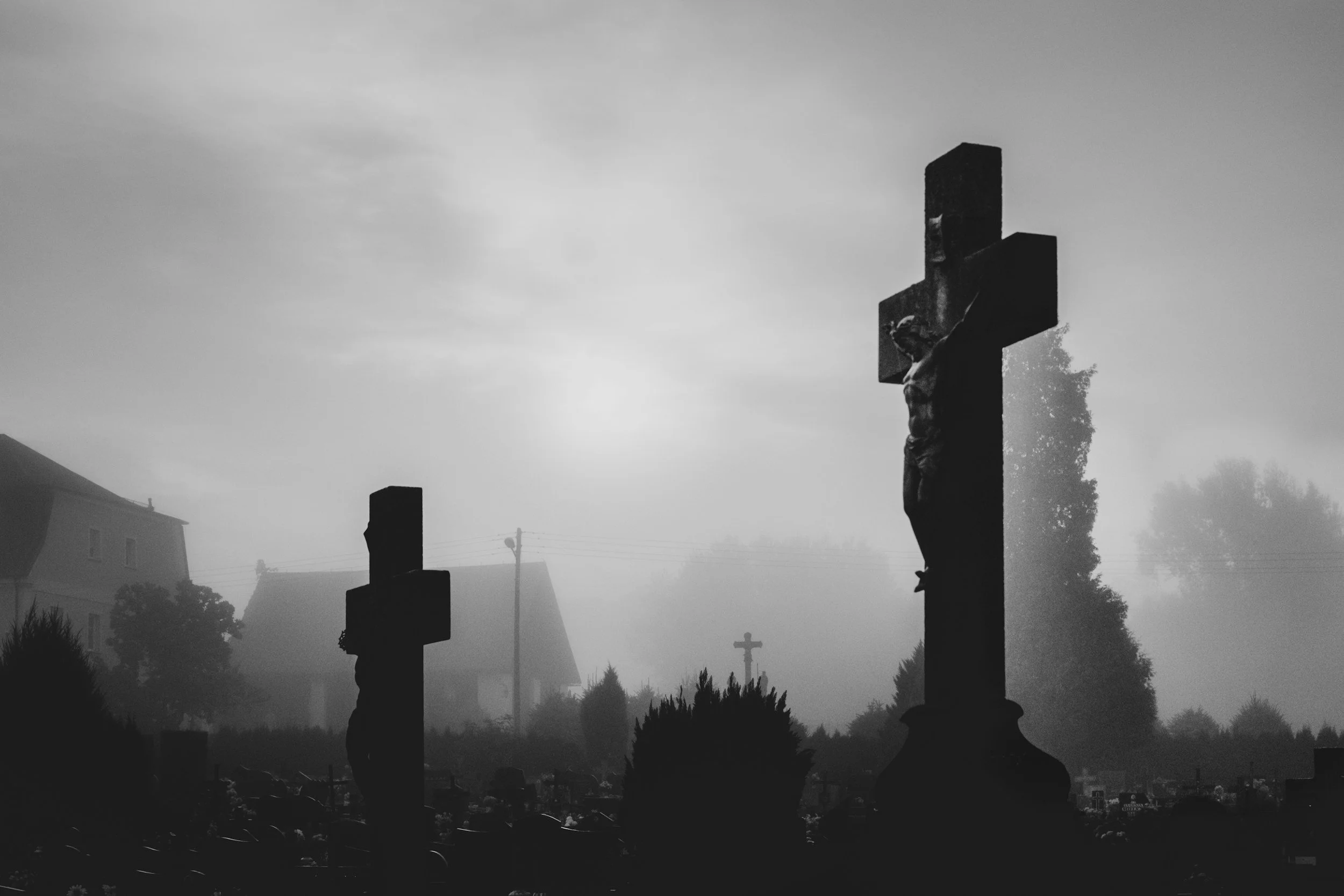
In the gaslit churchyards of 18th- and 19th-century Britain, there worked a profession that doesn't make it onto many career-day posters: the resurrection men. Grave robbers, body snatchers, "sack-'em-up men" — whatever you called them, their job was to dig up the very freshly buried and sell them, by night, to the anatomy schools. It's a properly macabre story. It's also, uncomfortably, one of the reasons I can do my job safely. Bear with me.
The birth of an unholy trade
The whole grisly economy grew out of a simple mismatch between supply and demand. As surgery and medicine became serious, evidence-based disciplines, anatomy moved to the centre of medical training — and you cannot learn anatomy from a textbook alone. You need bodies. A great many of them.
The law, however, was not co-operating. The Murder Act of 1751 (which came into force in 1752) decreed that the only corpses legally available for dissection were those of executed murderers — the gallows doubling as a grim deterrent and a teaching supply. It was meant to be a horror added to the horror of hanging: not just death, but the indignity of the anatomist's blade afterwards.
The trouble was arithmetic. Medical science was expanding far faster than Britain was executing murderers. Edinburgh and London were training hundreds of students a year; the noose simply couldn't keep up. Into that gap — as gaps in the market always are — stepped the enterprising and the unscrupulous.
The economics of death
Body snatching paid extraordinarily well. A single fresh corpse could fetch the equivalent of several months of a labourer's wages, which made braving the moral and physical hazards of a midnight churchyard a temptingly rational choice. A competent crew could have a body out of the ground and into a hessian sack in well under an hour, and a good night's work might yield five or six.
The technique was more craft than you'd think. The snatchers dug down at the head end only, cracked open the coffin lid with a lever, looped a rope under the arms and hauled the body out — leaving the shroud and any jewellery behind, because taking property was theft (and a serious crime), whereas a corpse, marvellously, belonged legally to no one. It was a loophole you could drive a cart through, and they did.
London's most notorious outfit was the Borough Gang, led by the fearsome Ben Crouch, who supplied the great anatomist Astley Cooper at Guy's and St Thomas'. We know their trade in unusual detail because one member, Joseph Naples, kept a business diary — the surviving Diary of a Resurrectionist, now held by the Royal College of Surgeons — logging bodies lifted, prices haggled and rival gangs feuded with, all in the flat tone of a man recording stock deliveries. Which, to him, is exactly what they were.
When snatching became murder: Burke and Hare
Here is where the story tips from ghoulish into genuinely monstrous.
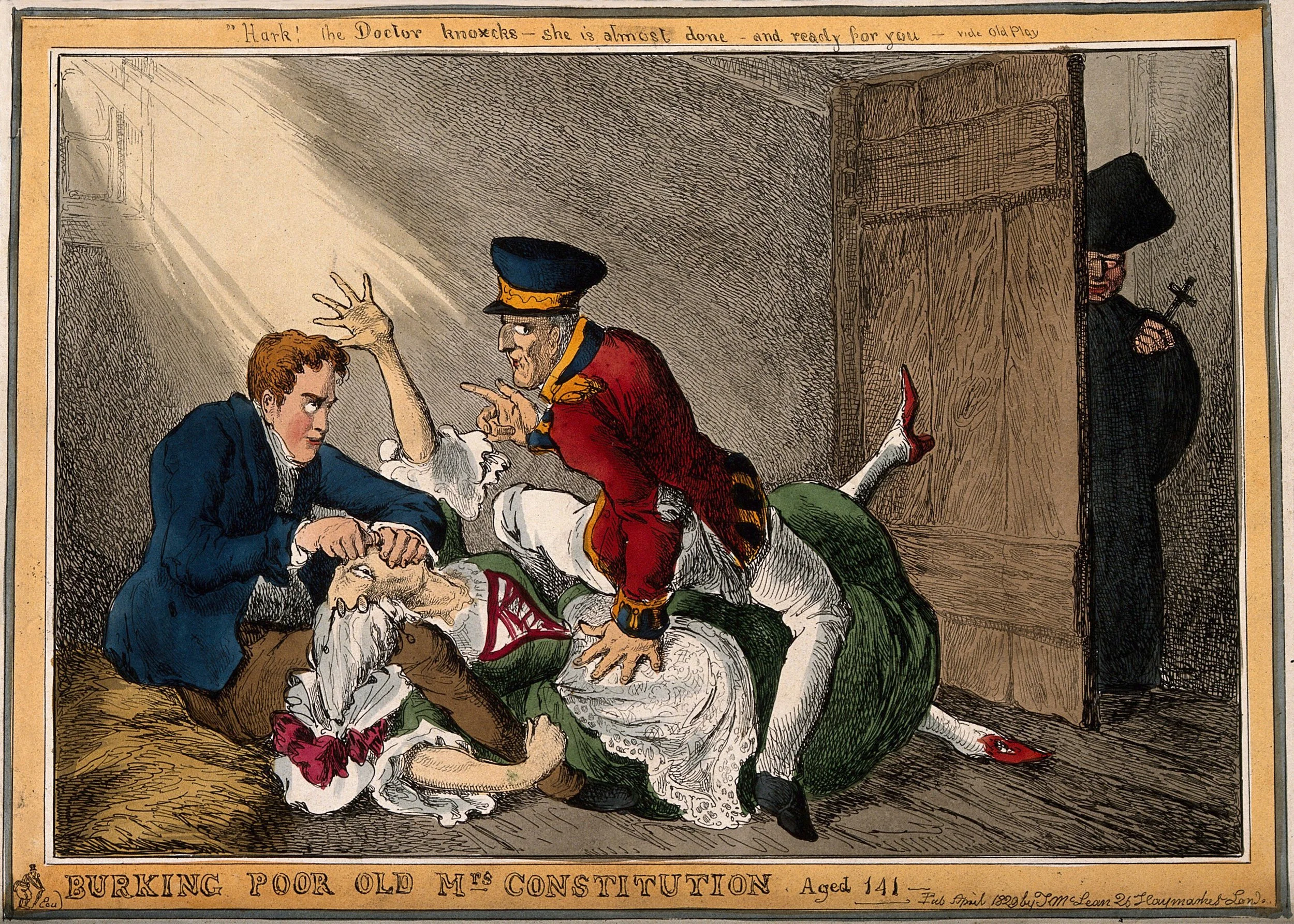
Wellington and Peel in the roles of the body-snatchers Burke and Hare suffocating Mrs Docherty for sale to Dr. Knox; representing the extinguishing by Wellington and Peel of the Constitution of 1688 by Catholic Emancipation. Coloured etching by W. Heath, 1829.
In Edinburgh in 1828, two Irishmen — William Burke and William Hare — worked out that the middle step of grave-robbing was tiresome, and that there was a faster route to a saleable body. Rather than exhume the dead, they made their own.
It began, as these things do, with opportunism. A lodger in Hare's boarding house died owing rent, and the pair sold his body to Dr Robert Knox, Edinburgh's star anatomist, to recoup the debt. Knox paid handsomely and asked no awkward questions — £8 in summer, up to £10 in winter, when bodies kept longer and demand ran higher. That silence was all the encouragement they needed. Over the following ten months, Burke and Hare murdered sixteen people — luring the poor, the drunk and the unmissed, and smothering them in a way that left no obvious marks and a perfectly fresh corpse.
Their second-to-last victim was James Wilson, known to all of Edinburgh as "Daft Jamie" — an inoffensive young man with a limp and a learning disability who begged in the streets and was recognised everywhere. When his body appeared in Knox's dissecting room, several students knew his face at once. It should have been the end. But Knox flatly denied the corpse was anyone's acquaintance and — tellingly — dissected Jamie out of turn, removing the recognisable head and feet first. Suspicion flared, and was smothered as neatly as the victims.
What actually undid them was Halloween. On 31 October 1828, they murdered their final victim, an Irishwoman named Mary Docherty. Two fellow lodgers, Ann and James Gray, grew suspicious, went poking about, and found her body hidden under the straw of a bed. They refused a bribe to keep quiet and went to the police. The scheme unravelled from there.
Hare turned King's evidence to save his own neck, testified against his partner, and walked free — last seen being escorted, in disguise, towards the English border, after which he vanishes from the record entirely. Burke was not so lucky. He was hanged on 28 January 1829 before a crowd of tens of thousands and then — with a poetry the mob relished — publicly dissected. His skeleton still stands in the Anatomical Museum of the Edinburgh Medical School; a pocketbook said to be bound in his own tanned skin, and his death mask, sit in Surgeons' Hall Museum a short walk away. The murders even gave English a new verb: to "burke" — to smother, and, more broadly, to quietly suppress.
Knox, the buyer who asked no questions, was never charged. A contemporary rhyme summed up the public's rough verdict: "Burke's the butcher, Hare's the thief, Knox the boy that buys the beef."
Edinburgh's horror was quickly imitated. In London a few years later, John Bishop and Thomas Williams — the so-called London Burkers — did the same thing, drugging and drowning their victims. Bishop eventually admitted to handling somewhere between 500 and 1,000 bodies across a dozen years, sold to King's College, St Thomas' and St Bartholomew's. Fittingly, they were caught when they tried to sell the too-fresh body of a boy to King's, and the anatomists there — finally — called the police instead of reaching for their wallets.
The law catches up: the Anatomy Act of 1832
Public revulsion at Burke and Hare, and at the body-snatching epidemic generally, finally forced Parliament's hand. The Anatomy Act of 1832 gave licensed doctors, anatomy teachers and bona fide students legal access to bodies for dissection — and in doing so pulled the rug out from under the resurrection men overnight. No black market can compete with a legal supply.
But read the fine print and the comfort curdles. The Act's "legal supply" was, in practice, the unclaimed dead — overwhelmingly the poor, who died in workhouses and hospitals with no family able to pay for a funeral or to object. It abolished one injustice and quietly built another: for the destitute, the fear of ending up on the slab simply moved from the graveyard to the poorhouse. The questions it raised about class, consent and who gets a say over their own body after death are ones medicine is arguably still working through.
From dark trade to modern surgery
Here's the part I find genuinely difficult to sit with, because it's true: the trade worked. Surgeons have to understand anatomy intimately, and they have to be able to rehearse on the dead before they ever touch the living — a principle that hasn't changed one bit. Edinburgh's fearsome reputation as a centre of surgery was built, in no small part, on the sheer volume of bodies the snatchers funnelled into its dissecting rooms.
The knowledge compounded. In 1858, Henry Gray published Anatomy: Descriptive and Surgical — the book we still call Gray's Anatomy — as a practical guide for students bent over a cadaver, telling them exactly what they were looking at. Nearly two centuries on, it remains a cornerstone of medical education. Much of the meticulous mapping behind it was done on bodies that arrived by routes no one wrote home about.
The legacy in my own field
And this is where it comes home to aesthetics, more directly than you might expect.
When I inject a filler, the single most important thing keeping my patient safe is not artistry — it's anatomy. Knowing precisely where the facial arteries run, how deep they sit, which "danger zones" can send filler into a vessel and, in the worst case, cause blindness or tissue death — that map is the difference between a good result and a catastrophe. Every safe injection, every facelift, every rhinoplasty rests on a detailed understanding of the layers, vessels and nerves of the face. That map was drawn, page by page, in dissecting rooms — including the ones once supplied by men with sacks and shovels.
The modern version is almost the mirror image of the old horror. Surgical trainees and aesthetic practitioners still learn on cadavers, but now with full consent, documentation and dignity for the donor. The ethical scaffolding the 1832 Act clumsily began has matured into genuine respect — informed consent, proper stewardship of human tissue, gratitude to those who donate their bodies to teach the next generation.
We got the anatomy and, eventually, the ethics. It only took a century and a national scandal.
The bottom line
The resurrection men are a reminder that medical progress rarely arrives clean. The knowledge that lets me keep a needle out of an artery, that lets a surgeon rehearse before they cut, was built in a morally murky place by people I would not have wanted to meet on a dark night — least of all this one.
So this Halloween, when you're enjoying something ghoulish, spare a thought for the sack-'em-up men and, more importantly, for the anonymous dead who ended up on the anatomist's table without ever agreeing to it. They are, in a very literal sense, the foundation the whole edifice stands on — one stolen body at a time. And be quietly grateful you live in the era of consent forms.
Happy Halloween. Mind the churchyards.
A note on this article: This is a piece of medical history written for interest and education, not a clinical or historical scholarly text; dates and figures are drawn from the sources below and the historical record is, in places, genuinely contested. Any modern clinical points are general information, not medical advice.

References
Murder Act 1751 (25 Geo. 2 c. 37) — the statute restricting legal dissection to executed murderers. Available from: https://en.wikipedia.org/wiki/Murder_Act_1751
Royal College of Surgeons of England. The Diary of a Resurrectionist (Joseph Naples) and the Borough Gang [Internet]. Available from: https://www.rcseng.ac.uk/library-and-publications/library/blog/diary-of-a-resurrectionist/
Ben Crouch and the Borough Gang — London's resurrectionists [Internet]. Available from: https://www.pascalbonenfant.com/18c/resurrectionists/thegang.html
Burke and Hare murders — victims, Robert Knox's payments, "Daft Jamie" (James Wilson), the Docherty discovery, Burke's execution and remains, and the verb "to burke" [Internet]. Wikipedia. Available from: https://en.wikipedia.org/wiki/Burke_and_Hare_murders
Royal Society of Edinburgh. When science met scandal: Dr Robert Knox and the Burke and Hare murders [Internet]. Available from: https://rse.org.uk/resource/dr-robert-knox-burke-and-hare-murders/
Mercat Tours. The Halloween crime of Burke & Hare — the murder of Mary Docherty, 31 October 1828 [Internet]. Available from: https://www.mercattours.com/blog-post/the-crimes-of-burke-hare
London Burkers (John Bishop, Thomas Williams) — the Edinburgh murders imitated in London [Internet]. Wikipedia. Available from: https://en.wikipedia.org/wiki/London_Burkers
Anatomy Act 1832 — legal reform of the supply of cadavers for dissection [Internet]. Available from: https://en.wikipedia.org/wiki/Anatomy_Act_1832
Gray H. Anatomy: Descriptive and Surgical (Gray's Anatomy), London; 1858 — history and enduring role in medical education. Available from: https://en.wikipedia.org/wiki/Gray%27s_Anatomy
Historic UK. Burke and Hare, grave robbers and murderers [Internet]. Available from: https://www.historic-uk.com/HistoryUK/HistoryofScotland/Burke-Hare-infamous-murderers-graverobbers/

On the night the veil between the living and the dead is supposed to thin, it feels only right to tell you about the people who made their living crossing it — the grave robbers whose grim, illegal trade quietly built the anatomical knowledge that every modern surgeon and doctor, myself included, still relies on.
In the gaslit churchyards of 18th- and 19th-century Britain, there worked a profession that doesn't make it onto many career-day posters: the resurrection men. Grave robbers, body snatchers, "sack-'em-up men" — whatever you called them, their job was to dig up the very freshly buried and sell them, by night, to the anatomy schools. It's a properly macabre story. It's also, uncomfortably, one of the reasons I can do my job safely. Bear with me.