
Mewing, Mouth-Taping and "Looksmaxxing": A Doctor's Guide to the Jawline Trend

There's a whole corner of the internet teaching teenage boys and young men to chase a chiselled jaw — some of it harmless, some of it genuinely dangerous, and quite a lot of it built on the advice of two dentists who've since been struck off.
Here's what actually works, what's nonsense, and the thing underneath it all that I think we need to talk about.
Most of my work — and most of this blog — has, historically, spoken to women. But there's a trend I can't really ignore any longer, because it's aimed squarely at boys, some of them very young, and because bits of it are landing people in trouble. It's called looksmaxxing, and if you have a teenage son, or you are a young man, or you've simply fallen down a certain kind of TikTok rabbit hole, you'll already know the vocabulary: mewing, mouth-taping, bonesmashing, "canthal tilt," "hunter eyes."
The easy move is to mock this latest trend, but mockery is exactly the wrong response. Let me explain what it all is, sort the sensible from the silly from the genuinely harmful — and then talk about the part that actually matters.
What "looksmaxxing" even means
Looksmaxxing is, put simply, the project of maximising your physical attractiveness — and it runs on a spectrum that its own community splits in two.
"Softmaxxing" is the benign end: skincare, a decent haircut, going to the gym, fixing your sleep, better grooming, sorting your posture. Honestly? Most of that is just... good advice. If the trend stopped there, I'd have nothing to write.
"Hardmaxxing" is where it tips over: surgery, unregulated injectables, anabolic steroids, appetite suppression, and a set of DIY techniques that range from useless to outright dangerous. This is the end that's aimed at your bones and your face, promising that with enough effort — or enough force — you can rebuild your skull into something the internet has decided is more "high value."
That promise is where the medicine comes in, because it is mostly not true, and occasionally it's a trip to A&E.
Mewing: the tongue posture that "sculpts" your jaw

Let's start with the big one. Mewing is the practice of pressing your tongue flat against the roof of your mouth, in the belief that holding this posture will, over time, sharpen your jawline and define your cheekbones.
Here's the origin story, and it's a doozy. The technique is named after a British orthodontist, Dr Mike Mew, and his father John Mew, who coined the term "orthotropics" and built a career arguing that jaw posture, not braces, was the key to facial development. The trouble is that the profession did not agree — and neither did the regulators. John Mew was erased from the UK dental register years ago. And in 2024, the General Dental Council struck Mike Mew off too, following a misconduct case involving inappropriate and misleading treatment. So the two men whose name is literally on this trend have, between them, lost the right to practise dentistry in this country. That's not a minor footnote. That's the whole headline, guys.
On the science: in a growing child, jaw development is genuinely influenced by things like airway, tongue position and breathing — which is why myofunctional therapy exists as a real, supervised discipline. But in an adult, your facial bones are fused and set. No amount of tongue-pressing is going to remodel your mandible into something new. What mewing can do is make you briefly hold your head and jaw differently, which changes how you look in a photo for as long as you're concentrating on it — that's posture, not bone. The dramatic "before and afters" you're seeing are lighting, angles, weight loss, and a flexed jaw held for the camera.
Now breathing through your nose rather than your mouth is good for you, and if you or your child chronically mouth-breathe, that's worth a proper look by a GP, dentist or ENT — because it can flag things like allergies or airway issues. But that's a medical assessment, not a TikTok exercise.
Mouth-taping: please, let's be careful
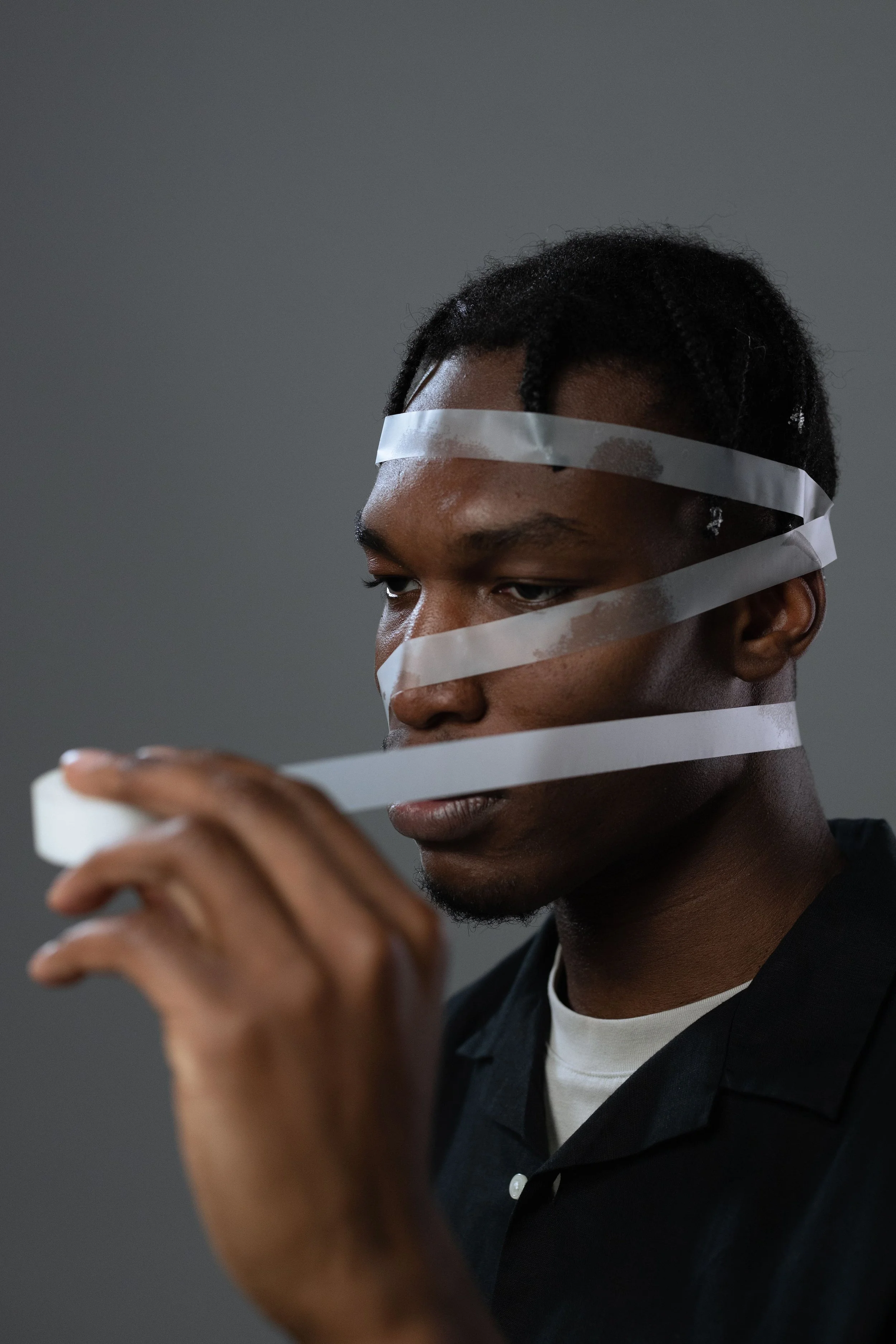
Which brings us to mewing's bedfellow: mouth-taping, the practice of literally taping your lips shut at night to force nasal breathing, supposedly for a sharper jaw, better sleep and more energy.
I'm going to be blunt here because this one has a genuine safety edge. In 2025, researchers published a systematic review of the actual evidence, pooling ten studies, and the conclusion was not kind to the trend: the data does not support mouth-taping for the general population with sleep-disordered breathing, and — this is the important part — several of the studies flagged a real risk of asphyxiation in anyone with nasal obstruction. And who tends to mouth-breathe at night? Frequently, people whose noses are blocked, or who have undiagnosed obstructive sleep apnoea — which is to say, precisely the people for whom taping your mouth shut is potentially dangerous rather than helpful.
If you snore, wake up unrefreshed, or think you might have sleep apnoea, the answer is a proper sleep assessment, not a roll of tape. Taping over the symptom can bury a diagnosis that actually matters for your heart and your life.
Bonesmashing: the point where I have to say "stop"
And then there's the far end, and I include it not to sensationalise but because young people are genuinely trying it: bonesmashing — deliberately striking your own facial bones with a hard object, in the belief that the micro-damage will trigger the bone to rebuild bigger and stronger.
This is a mangled misreading of a real principle (bone does remodel in response to load — think resistance training strengthening the skeleton). But that does not translate to hitting yourself in the face. What repeatedly traumatising your own facial bones actually risks is fractures, nerve damage, lumps of irregular healing, and disfigurement — the precise opposite of the goal. There is no version of this that a doctor can endorse. If you take one sentence from this article, let it be that one.

The part that actually matters
Here's where I want to stop being wry, because underneath the jaw exercises is something I find genuinely sad, and important.
Looksmaxxing didn't come from nowhere. It grew in the same online soil as some pretty toxic ideas about "high value" versus "low value" men, and for a lot of boys it's a gateway into corners of the internet that trade in self-loathing and blame. Mental-health researchers are increasingly clear that, for many, these behaviours aren't a hobby — they're a symptom. Obsessive fixation on a facial "flaw," compulsive checking and correcting, misery that doesn't lift when the jaw does: that's the territory of body dysmorphic disorder, and it is not a female-only condition. We too often miss it in boys and men, partly because we don't expect it and partly because they're praised for "self-improvement.” (For context: roughly one in three people affected by eating disorders is male — the stereotype has always undersold it.)
So if you're a young man reading this and any of it stings a little too much — if the mirror has become a battleground, if the "improvements" never feel like enough — I want you to know that's a recognised, treatable thing, and wanting help is not weakness. In the UK, the BDD Foundation (bddfoundation.org) and Beat (beateatingdisorders.org.uk) are good places to start, and if things feel darker than that, CALM (thecalmzone.net, 0800 58 58 58) is there for exactly this. And if you're a parent: the warning sign isn't the skincare or the gym. It's the distress underneath — the secrecy, the fixation, the joylessness. That's the moment to step in.
So what actually works?
Let me end constructively, because there's a real answer, and it's almost boringly wholesome.
The things that genuinely improve how you look are the things looksmaxxing borrowed and then ruined with extremes: sleep properly; move your body; eat enough (not less); look after your skin with a simple routine and — yes — wear sunscreen; get a haircut that suits you; stand up straight; and if your teeth or bite genuinely bother you, see an actual orthodontist, who can do more for your jawline with evidence behind them than any influencer with a chisel. None of that is exciting enough to go viral. All of it works, and none of it will hurt you.
The bottom line
Looksmaxxing is a fascinating, sometimes alarming window into how the pressure to look a certain way has finally arrived, in full force, for boys and young men — a pressure women have carried for a very long time. Some of it is harmless self-care with a silly name. Some of it is nonsense sold by people who lost their licences. And some of it is genuinely dangerous, both to faces and to fragile mental health.
The jaw you're chasing is mostly genetics, angles and good lighting. The wellbeing underneath it is the thing worth actually maximising — and unlike your mandible, that one you really can change.

References
Mewing (orthotropics) — overview of the technique, its origins and the lack of supporting evidence [Internet]. Wikipedia. Available from: https://en.wikipedia.org/wiki/Mewing_(orthotropics)
Mewing-craze dentist struck off the register [Internet]. Medscape; 2024. Available from: https://www.medscape.com/viewarticle/mewing-craze-dentist-struck-register-2024a1000kq3
Dentist struck off for inappropriate and misleading treatment [Internet]. Scottish Dental Magazine; 12 November 2024. Available from: https://www.sdmag.co.uk/2024/11/12/inappropriate-and-misleading-treatment/
Son of "orthotropics" inventor John Mew struck off by the General Dental Council [Internet]. Dentistry IQ; 2024. Available from: https://www.dentistryiq.com/dentistry/research-and-news/article/55250908/
Breaking social media fads: safety and efficacy of mouth taping in mouth breathing, sleep-disordered breathing, or obstructive sleep apnea — a systematic review. PLOS One. 2025. Available from: https://journals.plos.org/plosone/article?id=10.1371/journal.pone.0323643
No evidence for viral mouth-taping trend, sleep expert says [Internet]. Schulich School of Medicine & Dentistry, Western University; 2025. Available from: https://www.schulich.uwo.ca/about/news-events-community/news/2025/no-evidence-for-viral-mouth-taping-trend-sleep-expert-says.html
"Looksmaxxing" isn't just a TikTok trend — it often reflects severe body image issues in teen boys and young men [Internet]. The Conversation; 2025. Available from: https://theconversation.com/looksmaxxing-isnt-just-a-tiktok-trend-it-often-reflects-severe-body-image-issues-in-teen-boys-and-young-men-280567
Looksmaxxing may point to deeper body image issues in young men, mental health expert says [Internet]. PBS NewsHour; 2025. Available from: https://www.pbs.org/newshour/health/looksmaxxing-may-point-to-deeper-body-image-issues-in-young-men-mental-health-expert-says
The Body Dysmorphic Disorder Foundation (UK) [Internet]. Available from: https://bddfoundation.org/
Beat — UK eating disorder charity and helpline (supporting people of all genders) [Internet]. Available from: https://www.beateatingdisorders.org.uk/

A tech millionaire spends two million dollars a year, swallows dozens of pills a day, and once had his teenage son's blood pumped into his veins — all to avoid dying. It's a mesmerising spectacle. It's also, for almost everything that matters, a very expensive way of ignoring what we already know. Because the real longevity "hacks" are unglamorous, unpatentable, and backed by mountains of actual evidence. And look — maybe it’s boring, but it’s free.